Design Case Study
Enhancing financial in schools
Role
Product Designer / Frontend
Client
Adept
Duration
6 Months
Year
2023
01 / Overview
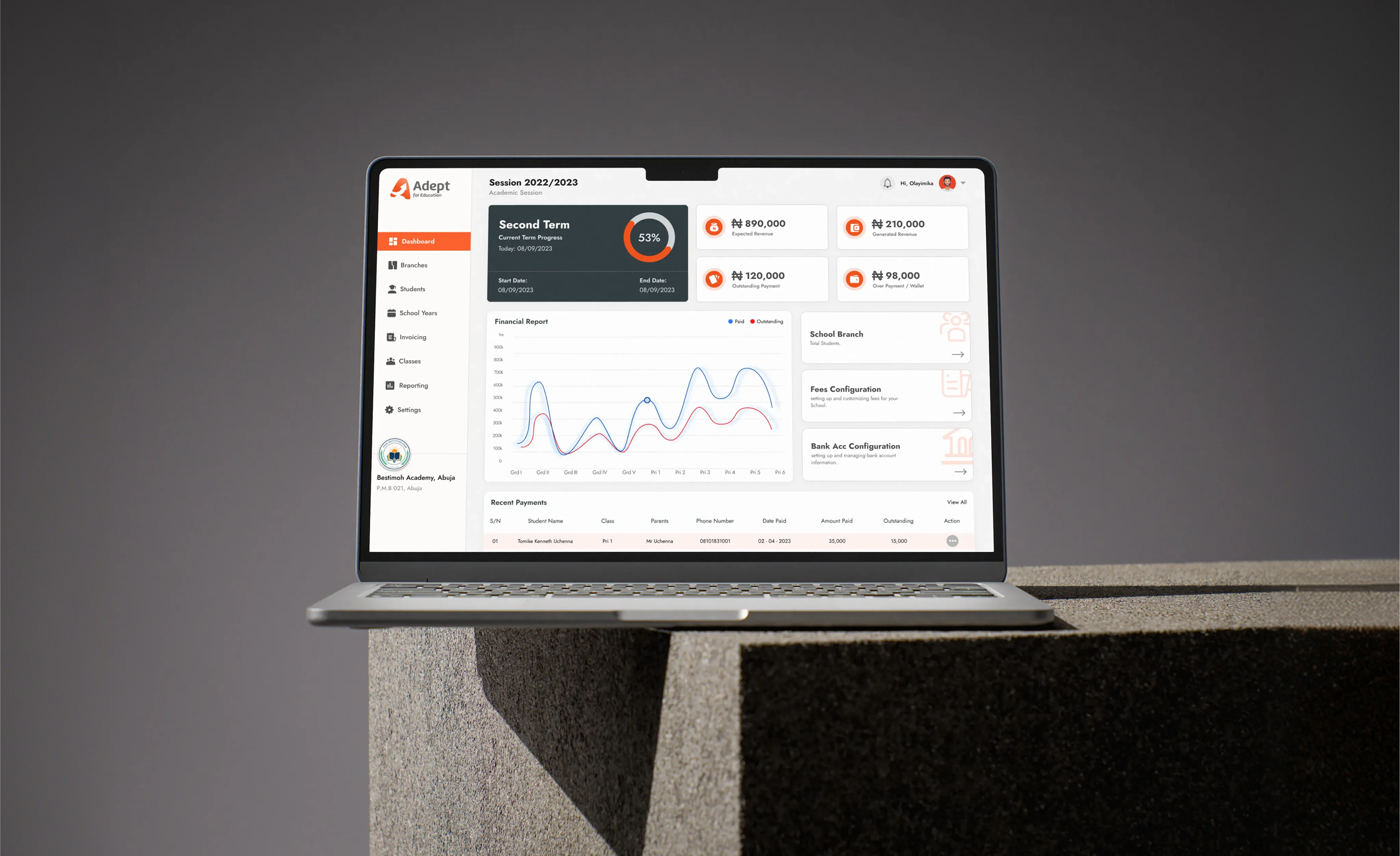
A unified school financial platform
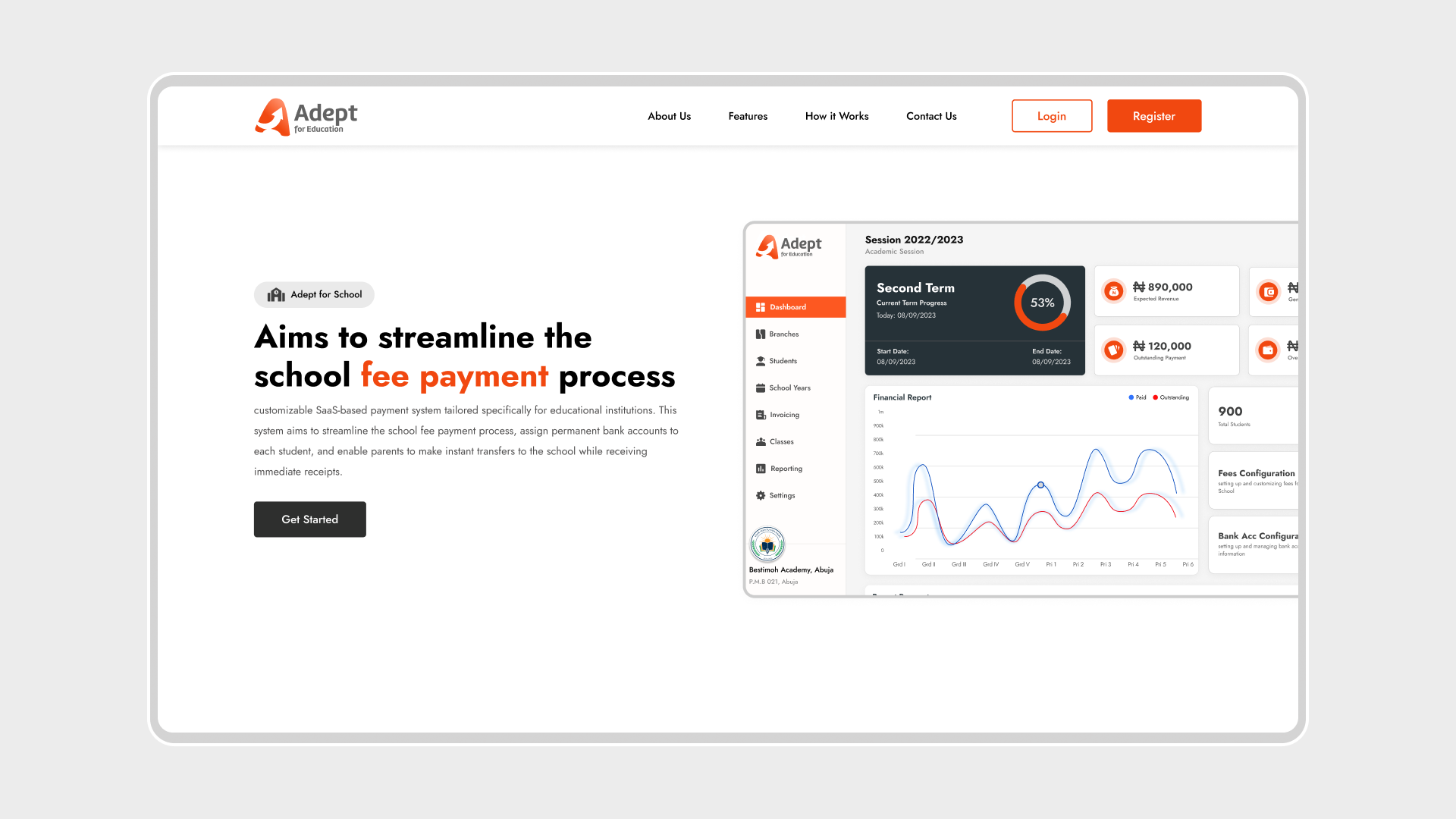
Adept for Education is a role-based platform that replaces manual, error-prone fee collection with an automated, real-time system for administrators, teachers and parents.
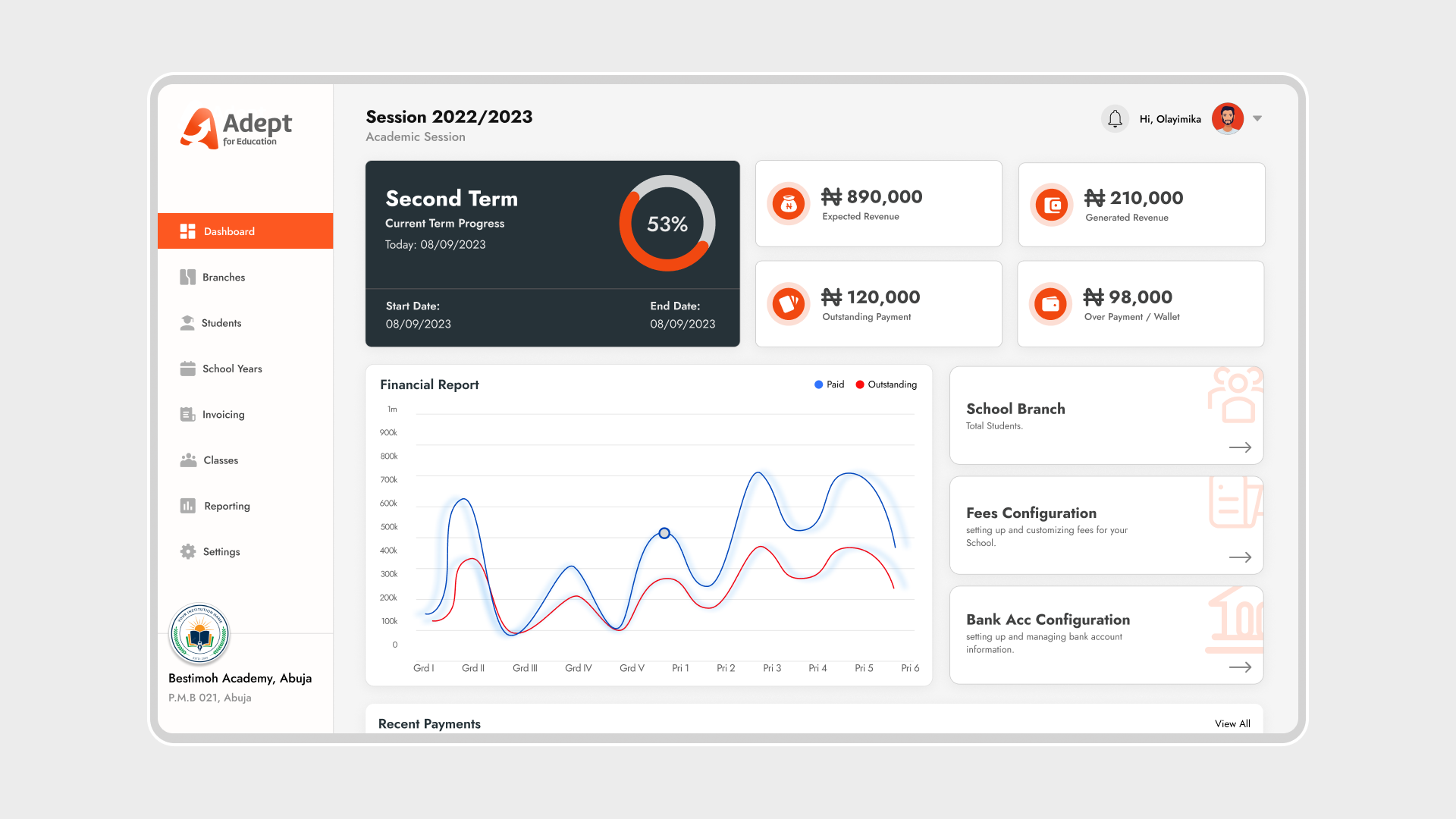
Each student is assigned a unique bank account number (NUBAN), enabling instant, traceable transfers with automated receipts. Parents get digital wallets, real-time fee visibility, and automated reminders, while administrators get a live financial dashboard, invoicing tools, and detailed reporting that replaces days of reconciliation with instant clarity.
I owned the end-to-end process (discovery research, synthesis, information architecture, low and high-fidelity design, and the design system) across a six-month engagement.
57.45%
of schools found manual fee collation difficult
7 days
max to reconcile a term's fees manually
3
user groups served: owners, teachers, parents
6 months
end-to-end design engagement
02 / Approach
Design process
A double-diamond framework: diverging to explore, converging to focus.
Discover
What is the nature of the problem?
Define
How can we scope the focus?
Develop
What are the potential solutions?
Deliver
What solution works?
Discover
- Contextual Findings
- Quantitative Research
- Insights
Define
- User Personas
- Problem Statement
Develop
- Affinity Mapping
- Information Architecture
- Wireframes
Deliver
- Style Guide
- Hi-fi Design
- Testing
Discover
Carried out research to gain a deeper understanding of the problem and uncover new insights, including user interviews, contextual observations, and market analysis.

Discover
Contextual findings
School Owner
Sets up and manages the software: branding, class and payment settings, and user management for the institution.
- Handling fee payments manually was time-consuming and error-prone, leading to inefficiencies in financial management.
- Lack of real-time data on collections and outstanding dues hindered accurate reporting and decision-making.
Teacher
Manages class activities: promoting students, deactivating them, and maintaining academic records.
- Tracking student progress and handling fee-related issues manually added to their workload, detracting from teaching.
- Without a centralised system, up-to-date enrollment and fee-status information was hard to obtain.
Parent
Uses the parent dashboard to track children's fees and wallet balances, manage payments, and view bills for multiple children.
- In-person payments required time and effort: long queues and restricted office hours.
- Uncertainty about fee structures, due dates and balances led to confusion and missed payments.
Discover
Quantitative research
Research objectives
- Evaluate the efficiency of fee-collection processes before Adept.
- Measure user satisfaction among administrators, teachers, parents and students.
- Assess the impact on administrative workload and academic management.
Hypotheses
- Adept significantly reduces fee-collection time.
- Users report higher satisfaction post-implementation.
- Teachers spend less time on admin, freeing focus for teaching.
What is your school type?
- Nursery & Primary only37.5%
- Secondary only22.56%
- Nursery, Primary & Sec15.97%
- Nursery & Creche11.48%
- Secondary & Tertiary7.78%
Manual fee collection before Adept
- Not easy to collate fee57.45%
- Not certain22.56%
- Easy to collate fee15.97%
Discover
Insights
Automating fee collection and admin tasks reduces manual errors and burden, freeing staff to focus on education.
A user-friendly interface integrates into daily operations, so teachers manage class activities more effectively.
A transparent, convenient payment system with automated reminders ensures timely fees and fewer missed payments.
Define
Examine and combine relevant information to fully understand the problem. Break down complex details to identify the core challenges, and refine that understanding into a clear, focused problem statement.

Define
User persona

Grace Adebayo
Name
Female
Gender
Abuja, Nigeria
Location
School Administrator, Bright Future Academy
Role / School
Motivation
- Streamline school operations to boost efficiency.
- Ensure prompt, precise fee-collection processes.
- Strengthen communication among staff, parents and students.
Frustrations
- Manual fee collection leading to errors and delays.
- Difficulty tracking outstanding payments and generating reports.
- Time-consuming admin tasks reducing focus on strategy.
Needs
- A streamlined system for managing fee payments and financial records.
- Tools to monitor student enrollment and class assignments.
- Efficient communication channels with teachers and parents.
Goals
- Introduce automated fee collection to minimise errors.
- Improve efficiency of school operations.
- Promote collaboration between staff, parents and students.
Define
User persona

Neemah Yakubu
Name
Female
Gender
Lagos, Nigeria
Location
Parent of three, Bright Future Academy
Role / School
Motivation
- Guarantee children's education continues without financial disruptions.
- Maintain transparent oversight of all school-related costs.
- Effectively manage and plan family finances.
Frustrations
- Uncertainty about the total amount due for all children.
- Lack of reminders leading to missed or late payments.
- Inconvenience of paying through traditional methods.
Needs
- A transparent system to view and pay fees for all children.
- Notifications for upcoming payments and additional charges.
- Access to payment history and receipts for record-keeping.
Goals
- Consolidate all payments into a single manageable platform.
- Receive timely reminders to avoid late fees.
- Access digital receipts for personal financial tracking.
Define
Problem statement
Educational institutions and parents face significant challenges managing fee collection and administrative tasks. Administrators are overwhelmed by manual processes, leading to errors and inefficiencies that hinder their focus on strategic initiatives. Parents, especially those with multiple children, struggle to track and make timely payments, resulting in stress and potential financial penalties.
These issues highlight the need for a streamlined, user-friendly system that automates fee management, enhances transparency, and improves communication among all stakeholders.
Develop
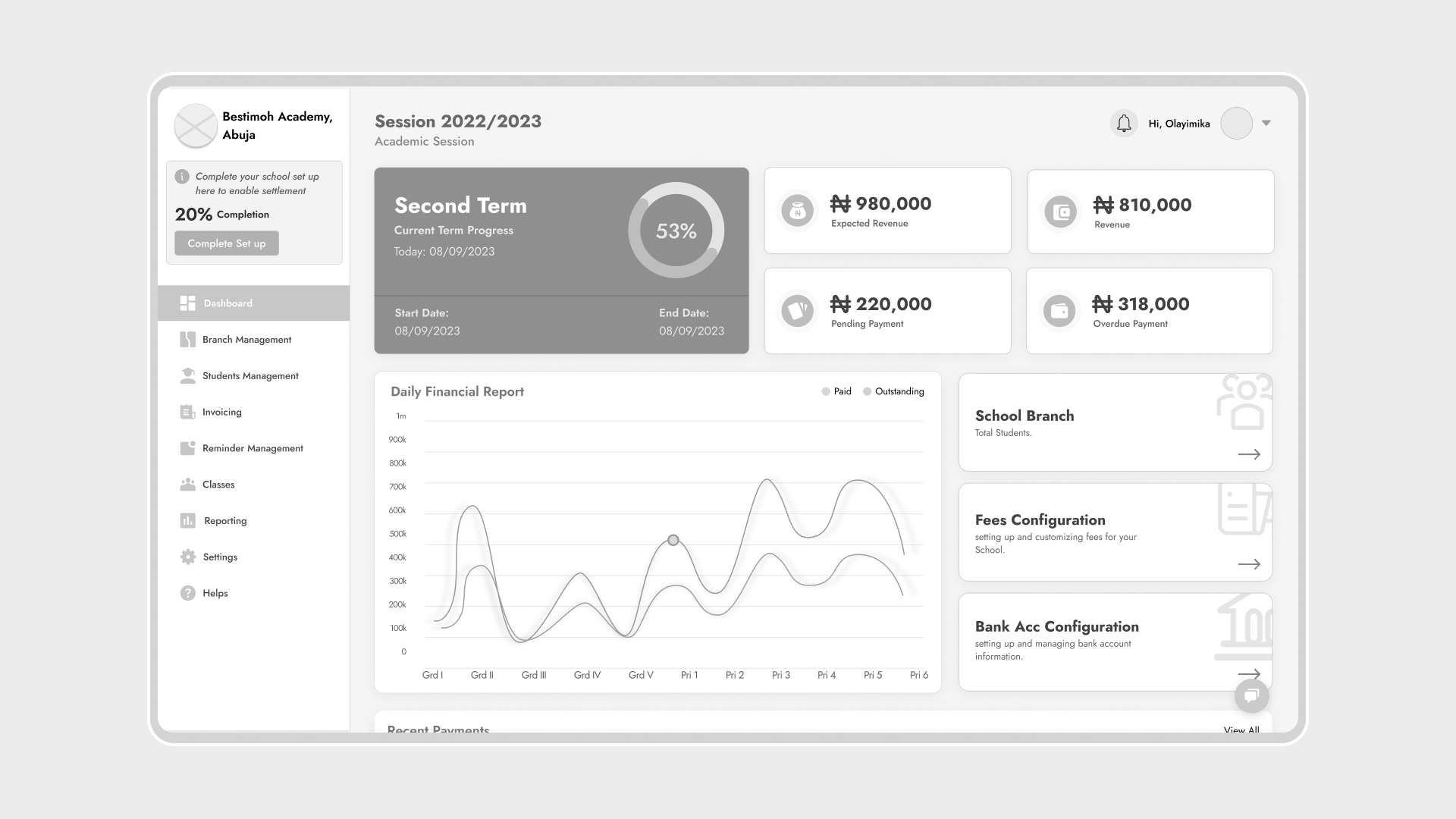
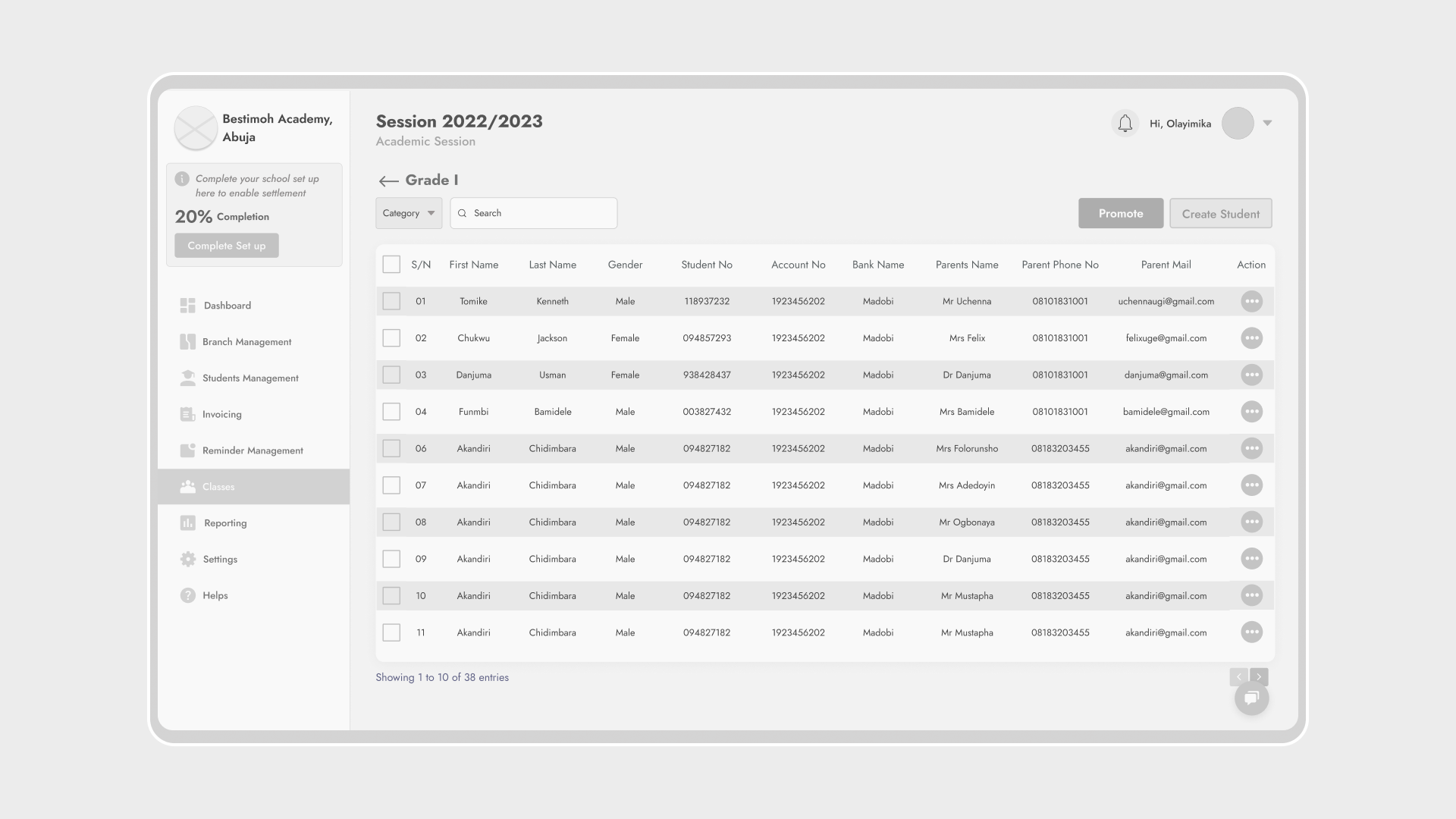
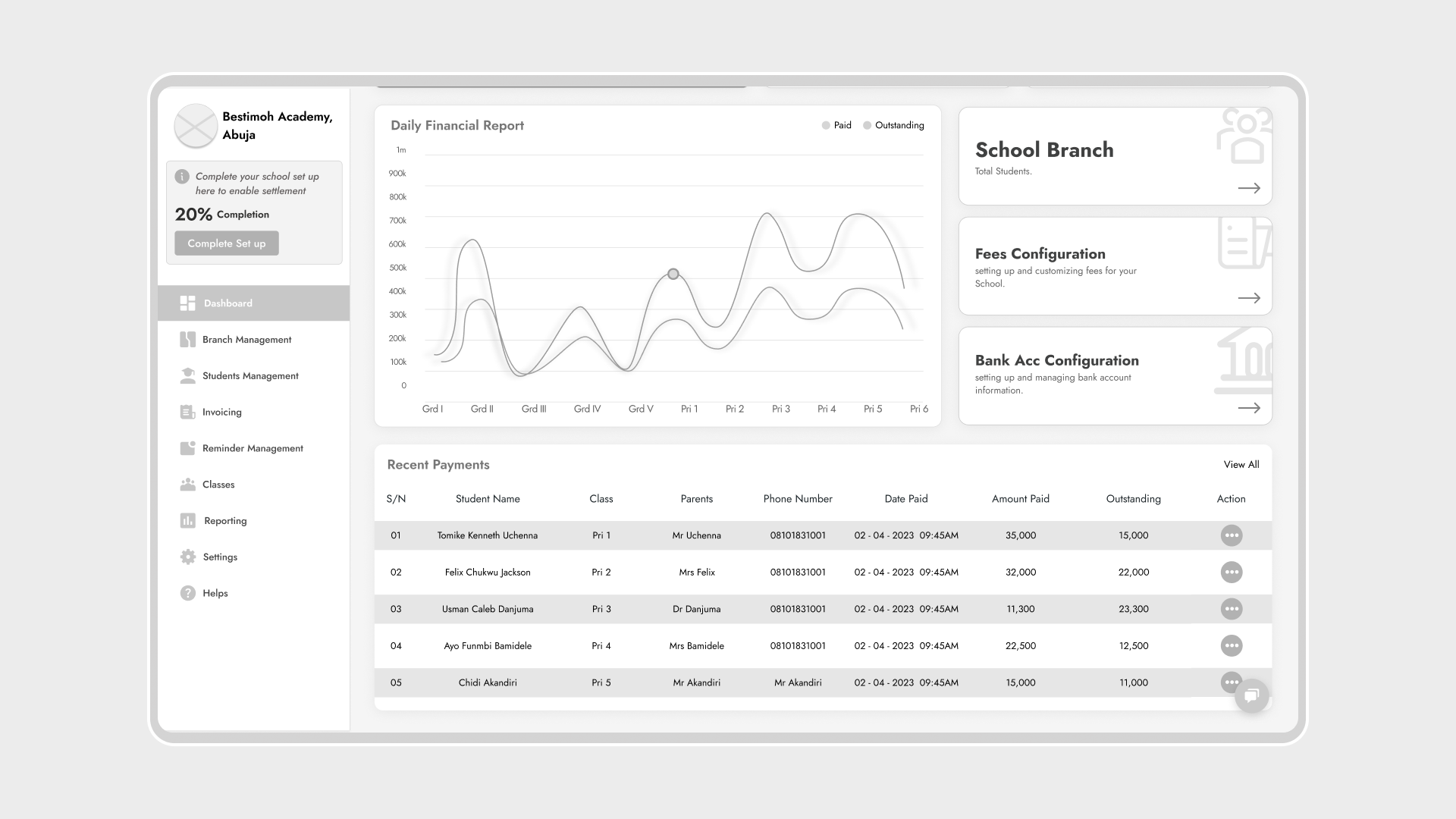
Generate a wide space of ideas, then organise and prioritise them. Map the system's pathways and stress-test layouts with low-fidelity wireframes before any visual design begins.

Develop
Affinity mapping
I clustered the brainstormed ideas into problems, matched them to solutions, and derived the features that would deliver each solution.
Develop
Information architecture: admin
I mapped the school-admin experience as a sitemap: a linear onboarding flow that lands on the dashboard, then a persistent navigation shell that branches into grouped modules, each drilling down to its screens.
Shared screens like Student Details, Invoice Details and Payments are also reachable from global search and from linked records, not only via the paths shown here.
Develop
Low-fidelity wireframes
Deliver
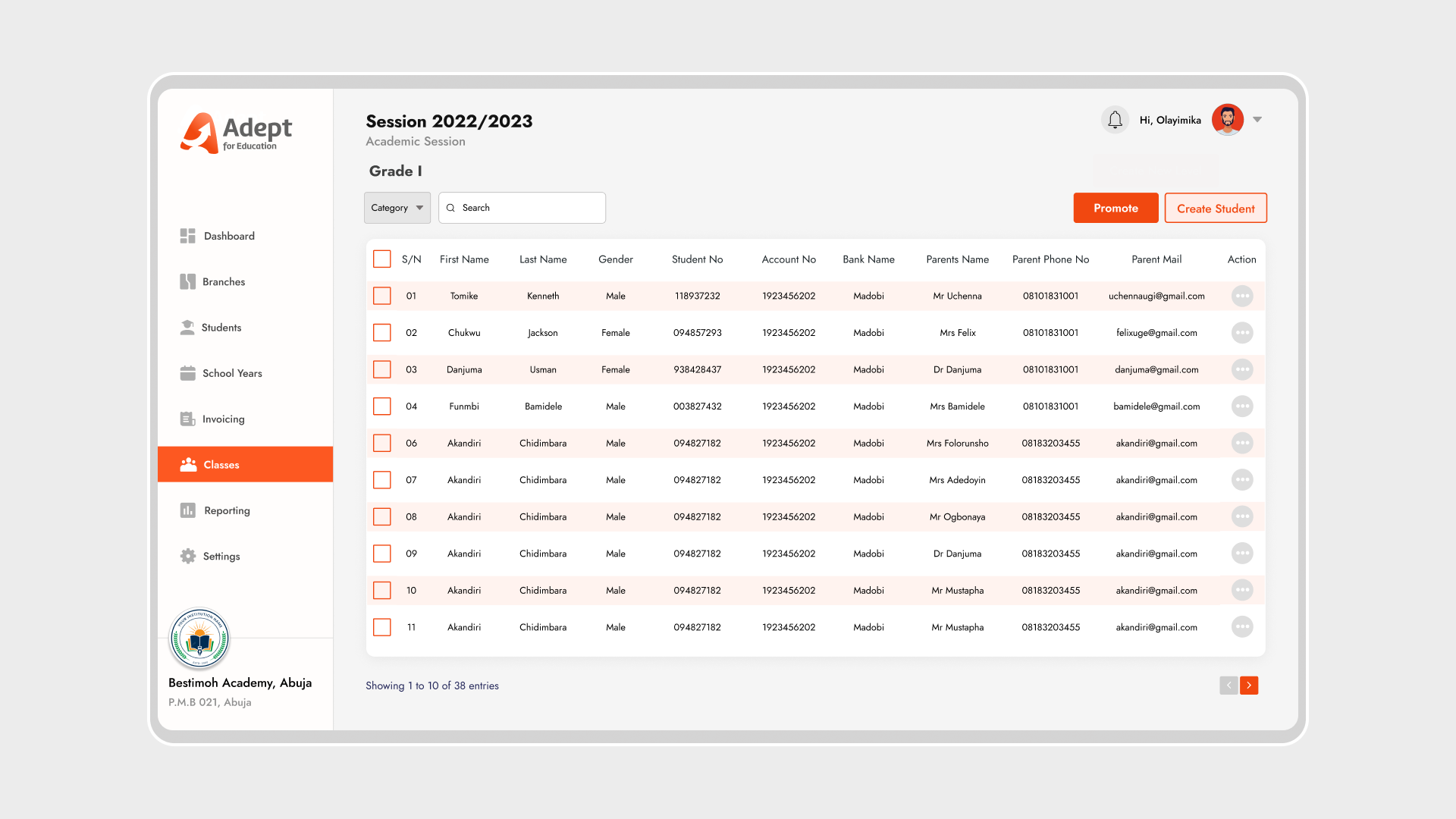
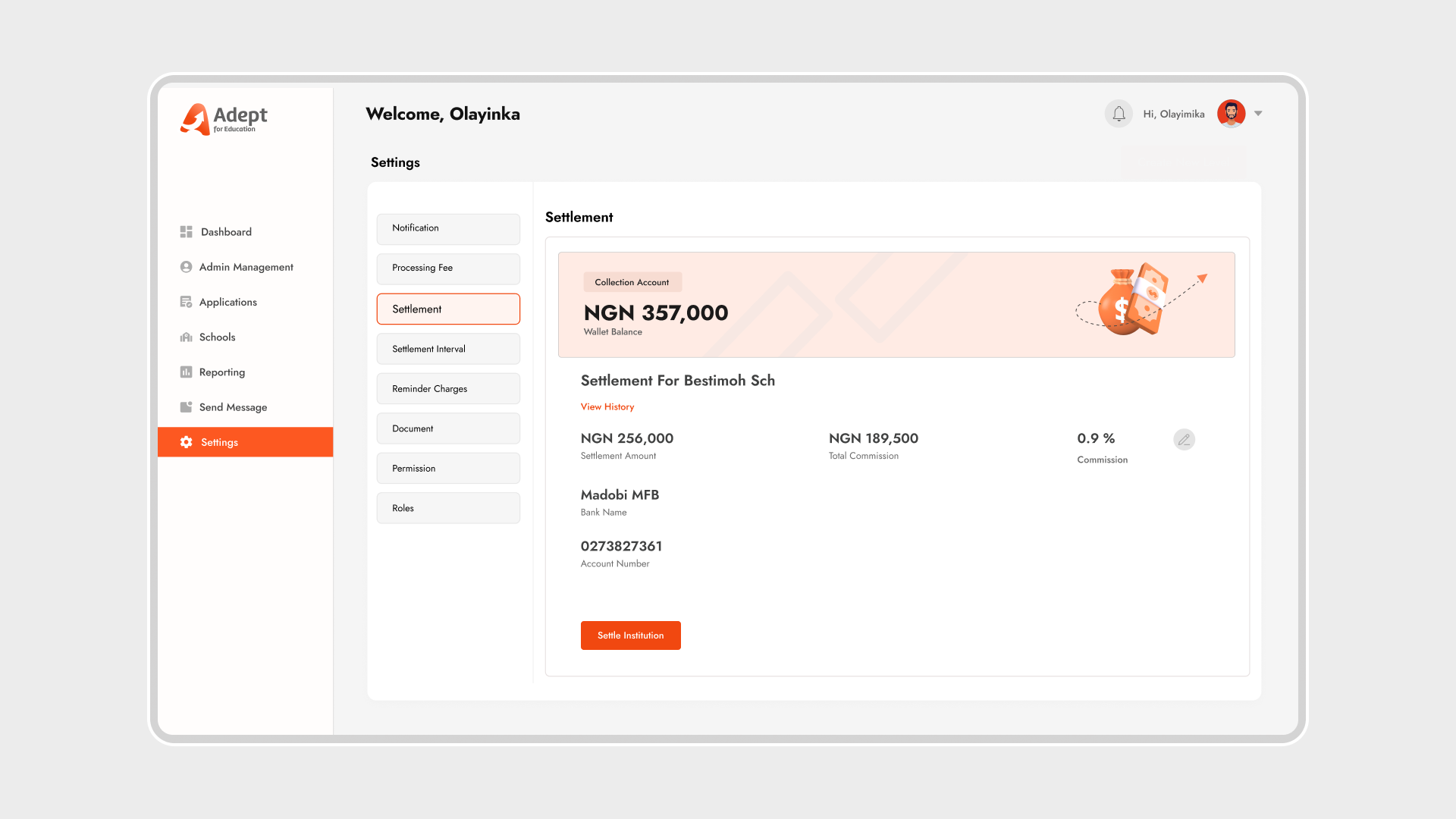
Establish the visual system, then produce high-fidelity screens for the school web app and the parent mobile experience, validated through usability testing and iteration.

Deliver
High-fidelity designs
Outcome
Reflection
Designing for multiple roles within one platform demands extreme discipline around information architecture. What feels intuitive for an administrator can overwhelm a parent.
The biggest win was resisting a single one-size-fits-all interface and committing to purpose-built experiences per role. The research also reinforced that the most impactful solutions are often process changes disguised as design decisions. Assigning unique bank accounts to students wasn't a UI choice, it was a workflow redesign that made an entire category of manual work obsolete.
Visit Website